

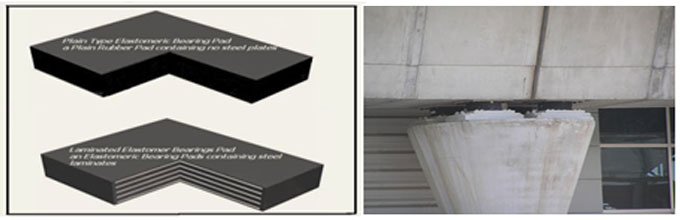
Bearings are devices which transmit the load from the superstructure to the substructure and to accommodate movements and displacements. Bearings are built to withstand loads and simultaneous deformation in any direction, while also allowing for minor rotations in any of the bearing's axes. IRC bearings can be made entirely of rubber or can be reinforced with special sheet steel to increase capacity and transversal strength.
- Plain Elastomeric Bearing containing no steel plate.
- Laminated Elastomeric Bearing containing steel plate laminated bonded to rubber.
- Laminated bearings are recommended for most cases since they give more reliable performance and better stability.
- Plain pad and strip bearings are suitable only for low loads and small shear strains.
- Temperature changes
- Traffic movement and braking
- Wind
- Shrinkage and creep
- Foundation movement
- Post stressing
- Vertical
- Shear
- Rotation
- To transfer the load from the superstructure (both vertical and horizontal) to the substructure. Bridges with span less than 10m do not normally require any bearings.
- To accommodate translational movements (expansion and contraction) e.g. movement due to temperature (can be large in steel bridges, up to 300mm); due to dead load & live load especially sloping road; shrinkage and creep etc.
- To accommodate rotational movements of deck girders. Rotation occurs as the deck deflect under load. Also, some relative rotations occur in composite section due to different properties of concrete and steel. Differential settlement may also cause some rotational movement.
- To limit forces transmitted to the substructures by suitable design.
- To provide damping of vibrations and minimize effects of impact loading in case of elastomeric bearings.
- Tensile Test Machine
- Oscillating die Rheometer
- Hardness Tester
- Compression set apparatus - deflection
- Specific Gravity Balance
- Thickness Gauge : 5mm and 25mm range
- Hot air Oven (250°C)
- Hardness
- Compression Set
- Tensile Strength
- Bonding Strength
- Elongation at break
- Load V/S Deflection test
Structures are subjected to imperceptible displacements and rotations that have to be accommodated to protect the structure and surrounding infrastructure. The most common causes of movement being:
The function of the bearing is to safely accommodate the various movements and rotations as well as supporting the weight of the structure and to transmit the load through to the structures foundation.
Moulding of IRC bearings pad is done on fully automatic CNC compression moulding machines with vacuum system which insures no air intrapment inside the rubber pad.
All operations such as shot blasting and bonding of steel plates, moulding, tooling and testing is being done by highly skilled manpower.
As per the IRC philosophy, fully equipped in house design & development, manufacturing and testing facilities for stage inspection and quality control have been established.
With a State-of-Art testing laboratory for rubber/polymer consisting of Tensile Testing (UTM), Rheometer(MDR), Hardness tester, Profile projector, specific gravity, Accelerated ageing ovens, quality of the product is always ensured in IRC Products.
Compound is tested for physical properties as per international standards in the test lab.
Material tests can be done and Certificates issued based on test values.
We have bearing testing facility to carry out tests confirming to AASHTO or other specification in accordance with Acceptance Testing on either Level I or Level II as well as Short/Long-Duration Compression Test. Our bearing testing machine can test bearings up to Vertical load of 4200 kN with horizontal shear load up to 400kN and movement up to 100mm.
 Download Laminated Elastomeric Bearing Pad Data Sheet